The concentration a small fragrance house approves at the sample stage is not automatically the concentration it can ship at bulk. Dosage changes what the formula costs, how it behaves on skin and on paper, and which material restrictions apply to the finished product. The workable approach is to fix the target concentration in a written specification before the bulk quotation, then verify the production batch against a retained reference from the approved round rather than against anyone's memory of it.
Key takeaways
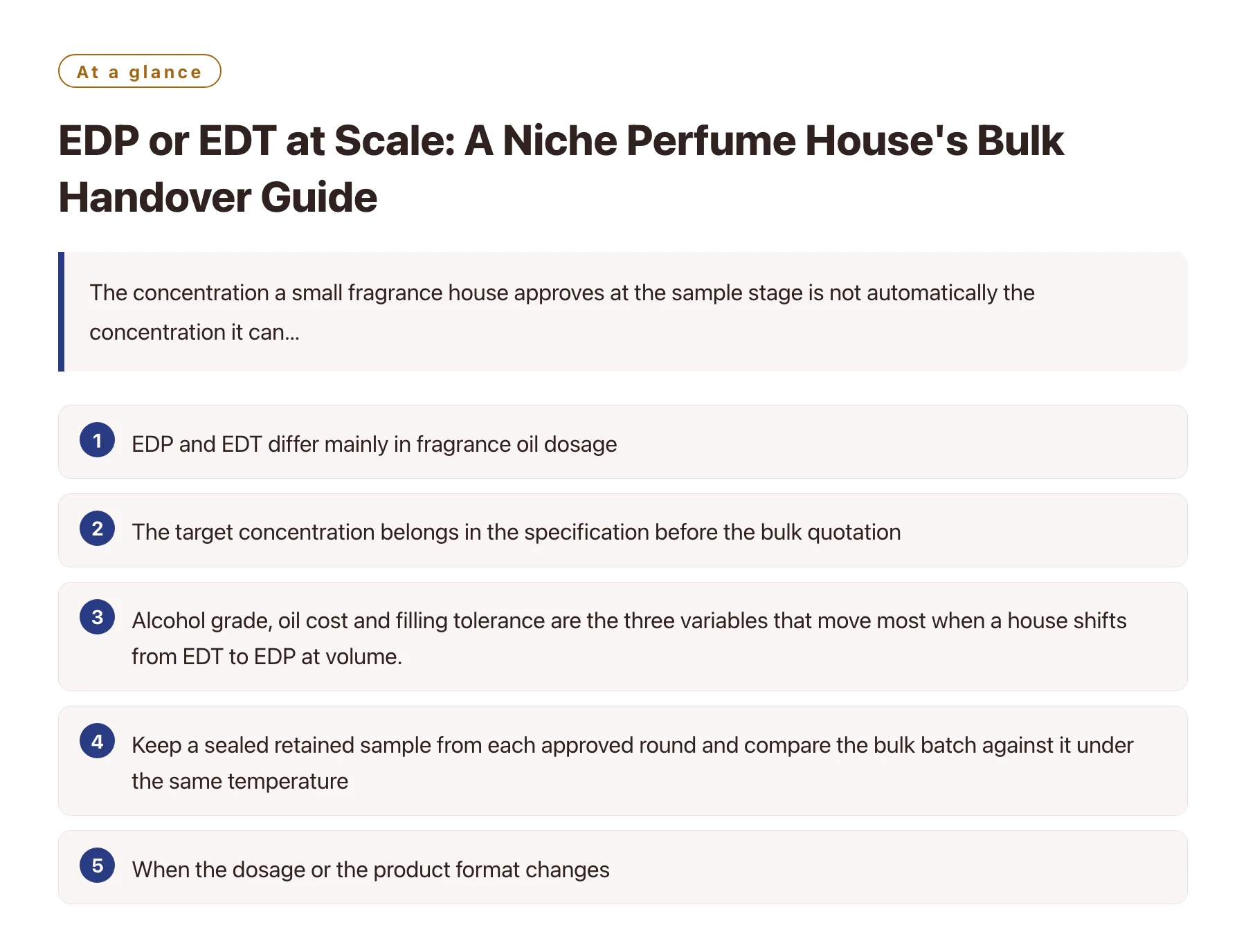
- EDP and EDT differ mainly in fragrance oil dosage, so the same concentrate can behave differently once the order scales and the dosage is fixed at production level.
- The target concentration belongs in the specification before the bulk quotation, because changing it afterwards resets costing, sampling and compliance work.
- Alcohol grade, oil cost and filling tolerance are the three variables that move most when a house shifts from EDT to EDP at volume.
- Keep a sealed retained sample from each approved round and compare the bulk batch against it under the same temperature, application method and reading time.
- When the dosage or the product format changes, re-check which material restrictions apply to the finished product instead of assuming the earlier check still holds.
A niche house usually chooses between EDP and EDT early, on the strength of a smell on a blotter and a story about what the brand is meant to be. That is a fine way to choose a direction and a poor way to choose a specification. The concentration decision has a cost side and a compliance side, and both only become visible when the project moves from a bench sample to a production batch.
This guide is written for a small house that already has an approved sample and is close to committing to a first bulk order. It does not argue that one concentration is better than the other. It sets out what has to be re-checked at the handover so that the bottle that arrives is the bottle that was approved.
What actually changes between a sample and a bulk batch
At the bench, a sample is made in a small quantity with a pipette and a scale. At bulk, the same formula is compounded in a far larger vessel, macerated, filtered and filled on a line. Each of those steps has a tolerance, and tolerance is where drift starts. A small difference in the weighed oil, the alcohol grade, or the number of days the batch rests before filling can move a fragrance enough that a trained nose notices it.
Dosage is the largest variable because it is the one most likely to be changed on purpose. If a house approves an EDT and later asks for an EDP to match a competitor's positioning, the oil load rises. That single change moves cost per unit, intensity at first spray, the drydown curve, and the way the finished product is assessed against material restrictions.
Manufacturers such as Xuelei keep a retained sample from every approved round precisely so that a later batch can be compared against something physical rather than against a description. It is a small habit that removes most of the ambiguity from a scale-up argument.
The other half of the job belongs to the brand. Someone on the team has to own the specification, and that person has to be able to say what the target dosage is, what tolerance is acceptable, and which sample the decision was based on. If nobody can answer those three questions, the factory will answer them by default.
Where an EDP decision reappears later
| Decision point | How it looks at the sample stage | What changes at bulk |
|---|---|---|
| Fragrance oil dosage | A few grams weighed on a bench, with the nose setting the level | Oil load is written into the specification and weighed at scale, so it locks in cost per unit |
| Alcohol grade and content | Often one alcohol is used for everything on the bench | Denatured grade, water content and permitted additives have to match the market the product is sold in |
| Performance on skin | Judged over one afternoon from a single application | The same dosage is judged by many users, in different climates, across months of shelf life |
| Material restrictions | Checked against the product category assumed during development | The finished product's category and market decide which restrictions apply, so the check has to be repeated |
| Fill tolerance | Pipette accuracy is not a production constraint | Pump or crimp fill volumes carry a tolerance that affects the declared volume on the label |
| Unit cost | Sample cost is absorbed as development spending | Oil, alcohol and packaging tolerances all feed the landed cost of every single unit |
Read the table as a list of items to settle in writing. Every row is cheaper to fix before the quotation than after the first production run.
Fix the specification before the quotation
Write the target as a number with a tolerance
A specification should state the fragrance oil percentage with an acceptable range, the alcohol grade, the fill volume with its tolerance, and the reference sample it was approved against. “Stronger than the last one” is not a specification, and it will be read differently by whoever compounds the batch.
Where the concentration is part of the brand story, write that down too. If the range is sold as an EDP, the label and the specification have to agree with each other, because a gap between the two is exactly the kind of detail a buyer or a market inspector can find.
Decide who holds the reference
Agree that both sides keep sealed samples from the approved round, stored under the same conditions and labelled with batch number and date. When a question comes up eighteen months later, that retained sample is the only evidence both parties can inspect together.
A bulk batch compared against a retained reference, at the same temperature and with the same application method, is a solvable problem. A batch compared against a memory is an argument. A partner that handles custom fragrance R&D and production will normally have a written procedure for this, and it is worth asking to see it before you sign anything.
Re-check restrictions when the dosage moves
Fragrance materials are restricted according to how and where the finished product is used, and the applicable limits are published in the IFRA Standards library. A formula developed for one product type is not automatically cleared for another, so a shift from EDT to EDP, or from a body product to a fine fragrance, deserves a fresh check rather than an assumption [1].
Keep the check proportionate. The manufacturer is responsible for supplying compliant materials and the supporting documentation; the brand is responsible for asking for it and keeping it on file. One email asking which restrictions were applied to the finished product, and on what basis, is usually enough.
The handover pack for a first bulk order
Keep the pack small and specific: the approved specification, retained reference samples, compliance documents for the materials used, fill and label tolerances, and a short note on storage and transport conditions. Everything else belongs in the project file rather than in the handover folder.
Understanding the stages of perfume production helps a small team decide which of these items has to exist before compounding starts and which can follow later. Dosing and compounding cannot wait; some of the label documentation can.
It also pays to prepare the internal explanation in advance. Someone in the company will eventually ask why the second batch smells a little different from the first, and having a short written note on why a sample and the bulk order can differ is far easier than reconstructing the answer in a meeting.
Finally, treat the handover as a date, not a mood. Book it before compounding, agree who signs the specification, and record what was approved. The cost of that half hour is nothing next to the cost of reworking a batch that was made to a target nobody wrote down.
Sources
- IFRA Standards Library (International Fragrance Association) —— The IFRA Standards Library lists the restrictions the fragrance industry applies to individual fragrance ingredients, based on safety assessments; it is the reference point for compliant fragrance formulation.
Frequently asked questions
Does an EDP always cost more than an EDT?
Usually, because fragrance oil is the most expensive component and an EDP carries more of it. The gap narrows when the EDT uses costly materials and the EDP uses a simpler blend, so compare cost per unit at the specification you actually intend to buy.
Can we move from EDT to EDP after the first order?
Yes, but treat it as a new development round. The dosage change affects performance, cost and the restriction check, so it should be sampled and approved again rather than edited into the existing specification.
How do we know the bulk batch matches the approved sample?
Compare a sealed retained sample from the approved round against the bulk batch under the same conditions: same temperature, same application method, same time on skin. Ask for the comparison to be documented rather than described.
Who decides the final concentration?
The brand decides what it wants to sell; the manufacturer advises what can be produced consistently at that dosage for the target markets. The written specification is the place where those two answers meet.
What if the label says EDP but the specification is lower?
That gap is a real risk and it is avoidable. Write the label claim from the specification, and make the specification the document the production batch is weighed against.