Sourcing hotel lighting from China works best when a project team turns its design intent into a controlled fixture schedule before requesting quotations. Each supplier needs the same information about location, appearance, performance, controls, mounting, documents, and delivery assumptions. That common basis lets buyers compare proposals and samples while keeping design approval, electrical review, compliance checks, and production release distinct.
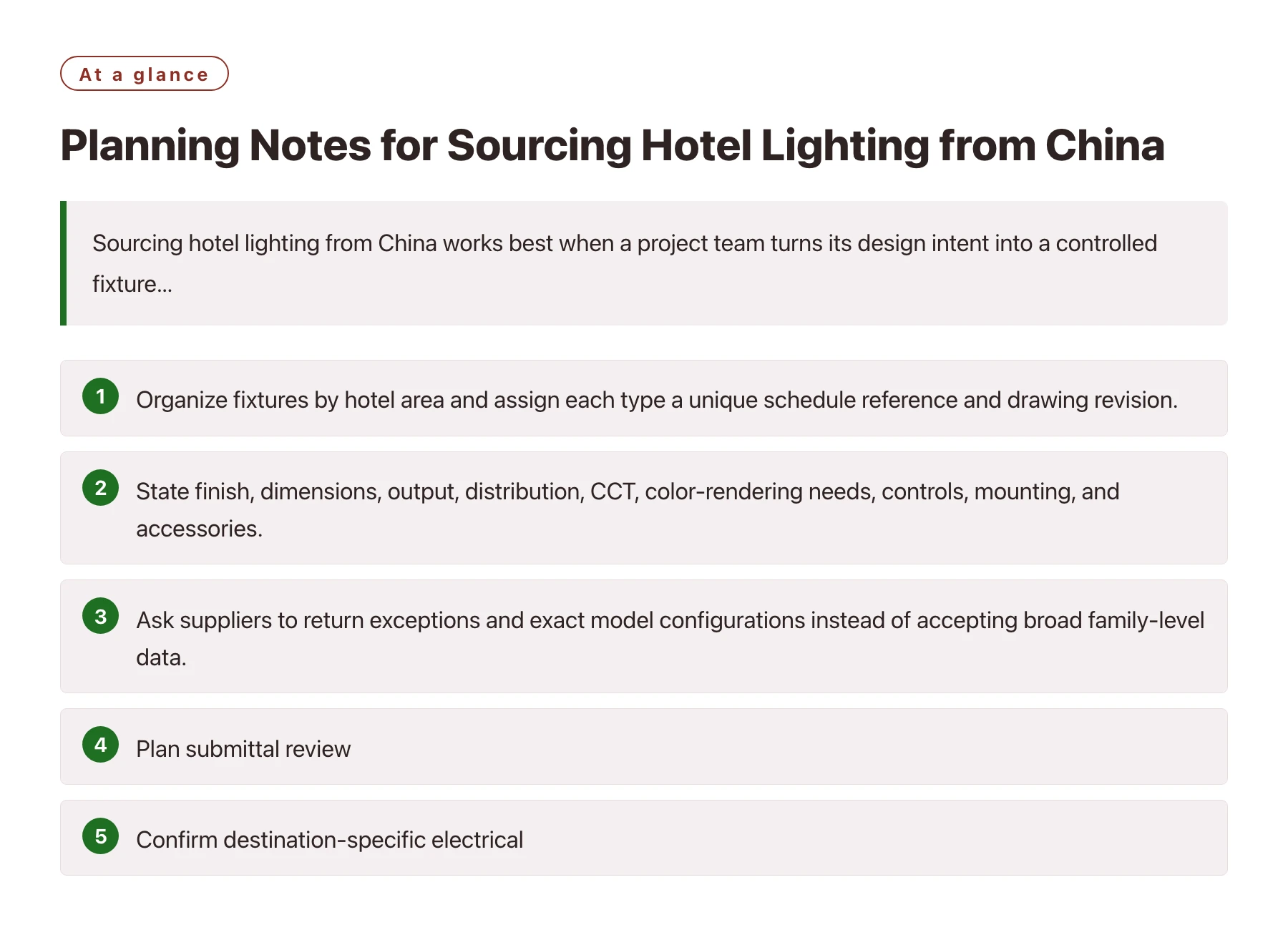
Key takeaways
- Organize fixtures by hotel area and assign each type a unique schedule reference and drawing revision.
- State finish, dimensions, output, distribution, CCT, color-rendering needs, controls, mounting, and accessories.
- Ask suppliers to return exceptions and exact model configurations instead of accepting broad family-level data.
- Plan submittal review, samples, mock-ups, tests, and production approval as separate project milestones.
- Confirm destination-specific electrical, safety, labeling, and documentation requirements with qualified reviewers.
- Tie packaging, spare parts, installation details, and delivery sequence to the room and construction schedule.
Hotel projects combine repeated room types with spaces that have different purposes and visual requirements. Guest rooms, bathrooms, public corridors, food and beverage areas, meeting rooms, exterior paths, and lobbies may use different fixture families and control scenes. The Illuminating Engineering Society's recommended practice for hospitality spaces organizes its coverage by these areas and describes lighting as an integrated system of layers.[1] That project structure can also help buyers organize supplier inquiries and review responsibilities.
Create a fixture schedule suppliers can quote consistently
Give each luminaire type a unique code and connect it to the room or area where it will be installed. Include the quantity, drawing reference, mounting method, dimensions, finish, light source, driver, control method, output or distribution requirement, accessories, and any design reference. Where the design uses a custom fixture, attach dimensioned drawings and identify which details are fixed and which may be proposed as equivalents.
State the required evidence for each line item. A supplier may need to return a marked schedule, technical data sheet, dimensional drawing, photometric file, electrical details, finish sample, test evidence, and a list of deviations. Tell suppliers how to name documents and which revision they must reference. If a value is not finalized, label it open and state who will decide and by when; otherwise suppliers may fill the gap with incompatible assumptions.
Separate visually similar variants. A downlight with another beam, finish, driver, or control can appear to be the same model in a short quotation while changing its installed behavior. Require the exact order code or a configuration table that links each option to its corresponding data.
Ask for proposals that expose deviations
Request the supplier to confirm each schedule requirement as compliant, proposed alternative, not offered, or needing clarification. Ask for evidence behind material claims and make the supplier identify the exact fixture model, driver, optics, and included accessories. This produces a reviewable exception list instead of a general statement that a product is suitable for hotels.
Compare the technical configuration and commercial scope together. Note tooling or customization charges, minimum order assumptions, spare parts, packaging, documentation, delivery terms, and which party handles installation or local commissioning. A lower unit price may reflect a different driver, finish, warranty scope, or excluded accessory, so the comparison should show the difference instead of treating headline prices as equivalent.
Ask how a supplier manages production revisions and component substitutions. If a driver becomes unavailable or a finish vendor changes, the project team needs a notification and approval route before the substitute is built into the order. Keep that route in the inquiry or purchase documents and connect it to the fixture schedule revision.
Review lighting metrics in relation to the space
Define the visual result required for each application rather than relying on a single number across the project. Correlated color temperature (CCT) describes aspects of a source's color appearance, while CRI and TM-30 provide ways to characterize aspects of color fidelity. The Department of Energy notes that CCT condenses information and that color metrics have limits, particularly for some saturated colors.[2] Use the project's designer or lighting consultant to set appropriate requirements for the intended surfaces, art, food presentation, mirror use, and guest tasks.
Photometric distribution, glare, dimming range, and light levels also affect how a room reads. Ask for data files for the actual proposed fixture and configuration. Have the design team review the files in the project's layout assumptions, including ceiling height, aiming, reflectances, furniture, and control scenes. A family-level data sheet may not represent the variant being quoted.
Avoid turning a metric into a proxy for a whole experience. Two products with the same CCT can differ in spectrum, distribution, glare, driver behavior, finish, and dimming response. If color matching across fixtures matters, ask the supplier how the product's color consistency is specified and what documents or tests support the claim.
Plan samples and mock-ups around decisions
Choose a sample type based on the open question. A finish chip can settle surface appearance; a powered sample can help evaluate light and controls; a room mock-up can show the interaction between fixture, furniture, materials, and mounting position. Label each sample with model, finish, driver, date, and schedule revision. Record what the sample does not prove, such as long-term performance or compliance with a destination regulation.
Schedule samples early enough to allow for review, correction, and approval before production release. Define who reviews design appearance, technical submittals, controls, electrical details, and safety documents. One party's sample approval should not be interpreted as technical approval unless that responsibility is explicitly assigned. When the design changes, issue a new revision and identify whether an existing sample remains valid.
For high-visibility fixtures, consider a representative full-scale installation under the actual control and mounting conditions. Test startup, dimming, alignment, glare, maintenance access, and coordination with adjacent finishes. Document the approved scene settings and any accepted deviation so a later production sample can be compared against a clear reference.
Check technical documents and destination requirements
Confirm the exact market where the fixture will be installed and identify the standards, electrical approvals, safety marks, labeling, and other technical documents required there. Responsibility can depend on the product, building, project contract, and local law. Ask the supplier for available reports and declarations, then have the project's qualified compliance or electrical reviewer confirm whether the evidence applies to the proposed model and configuration.
Check document identity carefully. The report or certificate should match the manufacturer, site where relevant, model, driver, voltage, and product family claimed in the quotation. If an evaluation applies only to a similar model, ask the issuer or a qualified reviewer whether the difference is within scope. Do not infer product compliance from a supplier's quality-management certificate or a document for another fixture.
Request installation and maintenance instructions in a usable format and language. The operations team may need wiring diagrams, driver identifiers, replacement parts, cleaning guidance, and product codes after handover. State delivery dates for these documents and link them to the as-built fixture schedule.
Align production, packing, and room delivery
Map the order to construction milestones and room packages. Identify which fixture types must arrive first, whether partial deliveries are acceptable, and how the warehouse will identify cartons for each area. Specify carton labels, fixture codes, quantities, fragile-item protection, moisture precautions, and any site-specific handling requirement. Ask the supplier to provide package dimensions and weights early enough for the logistics plan.
Before shipment, reconcile the packing list against the approved schedule and order quantities. Agree on inspection stages, visible-defect criteria, and how discrepancies are held and resolved. For custom or fragile fixtures, include a review of protective packaging and assembly instructions. Where replacement parts could delay room completion, plan a separately identified spare quantity and document where it will be stored.
When the sourcing team coordinates supplier communication, sample collection, and inspection scheduling, evaluate JS Sourcing hotel lighting sourcing against the project's handoffs and responsibilities. Keep design intent, code review, installation acceptance, and final sign-off with the professionals and owners assigned to those decisions.
Sources
Frequently asked questions
What should a hotel lighting RFQ include?
Include a controlled fixture schedule, drawings, exact performance and finish requirements, control details, required submittals, sample expectations, destination, delivery assumptions, and a format for supplier exceptions.
Can a supplier's catalog verify that a fixture meets local electrical rules?
A catalog can identify a product and its stated features, but the project should confirm the applicable local requirements and whether the supporting reports or approvals match the exact model and configuration.
When is a room mock-up useful?
Use one when the decision depends on the combined effect of the fixture, mounting, room finishes, geometry, controls, or visible glare. A small sample may not reproduce those conditions.
Should the project approve a substitute fixture if the original is unavailable?
Only after reviewing its effect on appearance, output, distribution, controls, technical approvals, maintenance, price, and schedule, and recording the decision against the controlled schedule revision.